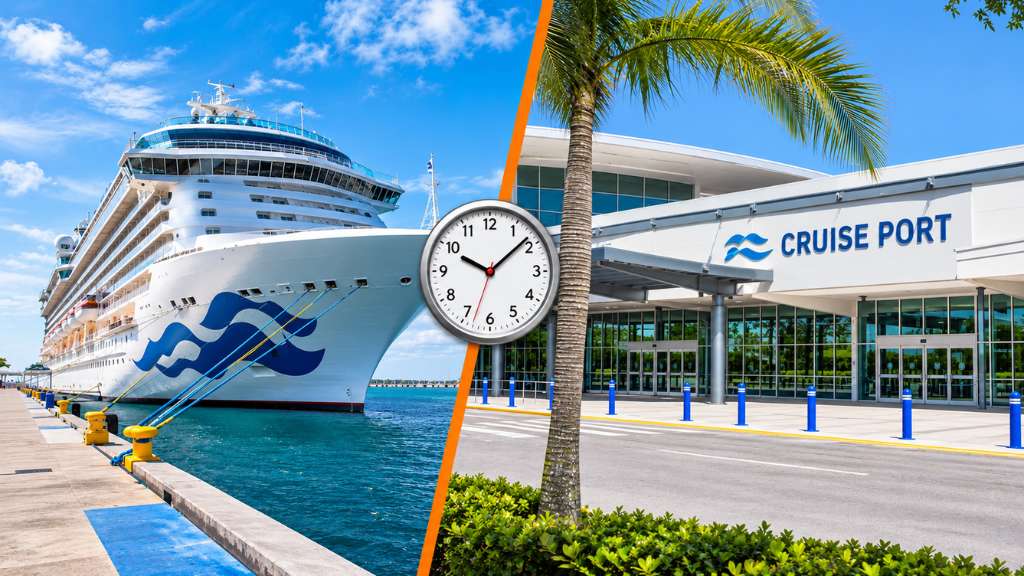
Cruise ship time vs. port time is one of the most important differences to understand before getting off the ship, especially when you’re exploring independently. Get the timing wrong, and you could arrive at the pier thinking you have plenty of time, only to discover that the ship has already left.
The confusing part is that your phone, the local shops, tour operators, and the ship may not all be showing the same time. That can create a dangerous mix-up when you’re trying to make it back before departure.
The good news is that avoiding this mistake is usually straightforward. You need to know which clock the ship uses, understand the all-aboard deadline, and plan your return with enough time to handle unexpected delays.
Here’s how cruise ship time and port time work, what to check before going ashore, and how to avoid being the passenger left watching the ship sail away.
Table of Contents
Cruise Ship Time vs Port Time: What’s the Difference?
Cruise ship time is the time the ship uses for its onboard schedule. Port time is the local time at the destination where the ship is docked.
Sometimes they’re exactly the same. Other times, they differ by an hour or more.
For example, imagine your ship is operating at 2:00 p.m. ship time while the local port time is 3:00 p.m. Your phone may automatically display 3:00 p.m. because it has adjusted to the local time zone.
If the ship’s all-aboard deadline is 4:30 p.m. ship time, you might mistakenly think you have an extra hour when looking at your phone.
That is how a simple time-zone misunderstanding can become a serious cruise problem.
The important rule: Always follow the ship’s stated time and all-aboard instructions when planning your return. Don’t assume your phone’s clock is showing the same time as the ship.
What You Need to Know Before Getting Off the Ship
Before leaving the ship in any port, check these five things. Understanding cruise ship time vs port time can help you avoid confusion and make sure you return before the all-aboard deadline.
1. Confirm the Ship’s Current Time
Don’t assume the ship automatically changes its clocks every time it enters a new time zone.
Cruise lines can have different procedures, and the ship’s operating time may not always match the local time.
Check the onboard announcements, daily schedule, cruise line app, or information provided by the crew. If you’re unsure, ask guest services.
2. Check the All-Aboard Time
The all-aboard time is the deadline by which passengers are expected to be back onboard. It is not necessarily the same as the ship’s scheduled departure time.
For example, a ship might be scheduled to leave at 5:00 p.m., but passengers may be instructed to return by 4:30 p.m.
That distinction matters. Arriving at the pier at the scheduled departure time is not a safe plan.
3. Check Whether Your Phone Has Changed Time Zones
Smartphones often update the displayed time automatically based on location and network settings.
That is convenient for everyday travel, but it can cause confusion on a cruise. Your phone may show local port time while the ship is still operating on a different time.
Before going ashore, compare your phone’s display with the ship’s stated time. If they differ, make sure you know exactly which one your return deadline uses. This is one of the most important things to understand about cruise ship time vs port time.
4. Check Your Excursion’s Return Time
If you’re booking an independent tour, don’t just ask what time it starts or how long it lasts.
Find out when it is expected to return and whether that timing leaves enough room for traffic, delays, and getting back to the cruise terminal.
A tour that finishes close to the all-aboard deadline is a risk, even if the operator says it normally runs on schedule.
5. Allow Time to Get Back to the Ship
Being in the right port at the right time doesn’t mean you’re automatically back onboard.
You may still need to travel from a beach, restaurant, attraction, or town center to the terminal. Depending on the port, you may also have to walk a considerable distance or use a shuttle.
Plan around the entire return journey, not just the time you expect to leave the attraction.
Why Cruise Ships and Ports Can Have Different Times
The main reason is that time zones don’t always line up neatly with cruise itineraries.
A ship may visit several destinations over a relatively short period. Depending on its route, the ship’s operating schedule, and the cruise line’s procedures, onboard time may differ from the local time at a port.
There are several reasons this can happen.
The Ship Is Following Its Own Schedule
The ship needs a consistent schedule for dining, entertainment, crew operations, and passenger activities.
The cruise line communicates the relevant onboard times so passengers know when activities happen and when they need to return. That schedule may not always match the local clock.
The Itinerary Crosses Time Zones
A cruise can travel between destinations that use different time zones. Even neighboring ports can sometimes have different local times, particularly when daylight saving time is involved.
The ship may adjust its clocks during the voyage, but you should never assume it has done so without checking.
Daylight Saving Time Can Cause Confusion
Some destinations change their clocks for daylight saving time, while others don’t. Some regions also change clocks on different dates.
This can make time differences less predictable than travelers expect. A time difference that was one hour on one part of an itinerary may be different later in the voyage.
The lesson: Don’t rely on a time-zone calculation you made before the cruise. Check the ship’s current instructions for each port.
What Happens If Your Phone Shows the Wrong Time?
This is one of the most common ways travelers can get confused about cruise ship time vs. port time. Imagine you get off the ship, walk around town, and check your phone to see how much time remains before all aboard.
Your phone shows 2:45 p.m. But the ship’s current time is 1:45 p.m.
If the all-aboard deadline is 3:00 p.m. ship time, you may think you have plenty of time when you actually have only 15 minutes.
The reverse can happen too. Your phone might show a later time than the ship, making you think you’re running behind when you have more time than you realized.
Either way, relying on an unverified phone clock is a bad idea.
How to Avoid the Phone Time Mistake
Before leaving the ship:
- Check the time displayed onboard.
- Confirm the all-aboard time and the time zone it uses.
- Compare your phone’s clock with ship time.
- Ask whether the ship plans to change its clocks.
- Consider keeping a second clock or watch set to ship time.
If you’re traveling with family, make sure everyone understands which time to follow. It’s easy for one person to check the ship’s schedule while another relies on a phone showing local time.
Understanding cruise ship time vs port time can help everyone stay on the same schedule and avoid a costly mistake.
Ship Time vs Port Time: Which Clock Should You Follow?
Follow the ship’s stated time for all-aboard deadlines and onboard schedules. Local time is useful for understanding the destination, but it should not replace the ship’s instructions.
Here’s a simple comparison:
| Situation | Which Time Matters? |
|---|---|
| All-aboard deadline | Ship’s stated time |
| Scheduled ship departure | Ship’s stated itinerary time |
| Onboard dining and activities | Ship’s schedule |
| Local shops and restaurants | Local port time |
| Independent tour meeting time | Confirm the time zone with the operator. |
| Returning to the cruise terminal | Ship’s all-aboard time, with a safety buffer |
There is one important detail: don’t assume that every time printed on a tour confirmation is ship time. Independent operators generally work with local time, but you should confirm this rather than guess.
When in doubt, ask the tour operator and compare its schedule with the ship’s instructions.
The Biggest Mistake: Confusing All-Aboard Time With Departure Time
This deserves special attention because it can catch even experienced cruisers. Understanding cruise ship time vs port time is important, but knowing the difference between departure time and all-aboard time is equally essential.
The scheduled departure time is when the ship is expected to leave port. The all-aboard time is the deadline passengers are instructed to meet. Those are not interchangeable.
If the ship is scheduled to depart at 6:00 p.m., that doesn’t mean you should plan to arrive at the terminal at 5:55 p.m.
The ship may begin its departure procedures before the advertised departure time. Crew members also need to account for passengers, gangway operations, and other preparations.
Treat all-aboard time as your personal deadline, not the ship’s departure time.
I would aim to be back in the terminal area well before that deadline. The exact buffer depends on the port, transportation, and distance from your activity, but leaving your return until the last few minutes is an unnecessary gamble.
When comparing cruise ship time vs port time, always use the ship’s confirmed all-aboard deadline to plan your return.
What Happens If You Miss the Cruise Ship?

If you return after the ship has departed, the situation can become expensive and stressful. The ship generally won’t wait indefinitely for passengers who are late returning from independent activities.
What happens next depends on the port, the cruise line, your travel documents, and the circumstances.
You may need to:
- Contact the cruise line or its local representative.
- Arrange transportation to another port on the itinerary.
- Pay for flights, hotels, or other travel arrangements.
- Make arrangements to retrieve your passport and belongings if they remain onboard.
- Deal with immigration and entry requirements.
Your cruise line may have a local port agent who can explain the available options, but you shouldn’t assume the company will automatically pay to get you to the next destination.
This is one reason independent excursions require more planning. If you’re exploring on your own, you are responsible for getting back within the required time.
Does the Ship Wait for Late Passengers?
Sometimes a ship may delay departure for a passenger-related issue, but you should never count on it.
The crew has operational requirements, port restrictions, and a schedule to maintain. A ship may wait in certain circumstances, but that is not a guarantee.
There is also an important difference between a passenger being late after an independent excursion and a delay involving a cruise-line-sponsored excursion.
If a cruise-line-sponsored excursion is delayed, the cruise line generally has procedures to manage the situation. Independent excursions don’t automatically receive the same protection.
Never book a risky independent activity on the assumption that the ship will wait for you.
Cruise-Line Excursion vs Independent Tour: Which Is Safer?
The time difference between ship time and port time is especially important when deciding how to explore a destination.
Both cruise-line excursions and independent tours can be good options, but they have different advantages.
| Option | Main Advantage | Main Risk |
|---|---|---|
| Cruise-line excursion | The cruise line coordinates the activity and has procedures for delays | Often less flexibility and may cost more |
| Independent tour | More choice and potentially better value | You’re responsible for returning on time |
| Exploring independently | Freedom to set your own schedule | Transportation delays can be difficult to predict |
For a port close to town, walking around independently may be perfectly reasonable.
For a destination involving long drives, ferries, remote beaches, or complicated transportation, I would be more cautious.
If the activity is far from the ship, the extra cost of a cruise-line excursion may be worthwhile for the additional coordination and peace of mind.
How to Plan Your Port Day Without Getting Stranded
You don’t need to spend your entire port day watching the clock. You just need a sensible plan.
Step 1: Check the Ship’s Instructions Before Leaving
Confirm the current ship time, all-aboard deadline, and any time-zone information provided for that port.
Don’t rely on what happened at the previous destination.
Step 2: Check the Distance From the Port
Find out how long it takes to get from the terminal to your planned destination.
Remember that a port name doesn’t always mean the ship docks close to the main town or attractions.
Step 3: Choose a Realistic Return Time
Work backward from the all-aboard deadline.
Include time for transportation, traffic, walking, waiting for shuttles, and unexpected delays.
Step 4: Keep Your Return Flexible
Avoid planning activities that leave you with almost no room for error.
A beach day that ends well before all aboard is usually a better choice than a distant attraction with a tight return schedule.
Step 5: Keep Important Information With You
Take the ship’s contact information and any details provided about the local port agent.
Also make sure you have the travel documents and identification required for your port visit.
Step 6: Recheck the Time During the Day
If you move between areas, change transportation, or spend longer somewhere than expected, check your remaining time again.
Don’t let a relaxed port day turn into a race back to the ship.
Common Mistakes to Avoid Related to Cruise Ship Time vs Port Time
Mistake 1: Assuming Your Phone Shows Ship Time
Why it is a problem: Your phone may automatically switch to local port time, which can differ from the time used for the ship’s all-aboard deadline.
Extra considerations: Other devices in your group may display different times depending on their settings and network connections.
Better alternatives: Compare your phone with the ship’s stated time before leaving and keep a reliable reference for ship time.
Mistake 2: Treating Departure Time as the All-Aboard Deadline
Why it is a problem: The ship may require passengers to return before its scheduled departure. Arriving at departure time can be too late.
Extra considerations: The all-aboard time may be communicated through onboard announcements, the daily schedule, or the cruise line app.
Better alternatives: Record the actual all-aboard deadline and plan to return with a comfortable buffer.
Mistake 3: Booking an Independent Tour That Returns Too Close to All Aboard
Why it is a problem: Traffic, mechanical problems, weather, or other delays can leave you stranded.
Extra considerations: A tour operator’s estimated return time isn’t a guarantee, especially when traveling a long distance from the port.
Better alternatives: Choose an earlier return or consider a cruise-line-sponsored excursion for distant activities.
Mistake 4: Assuming the Ship Will Wait
Why it is a problem: A ship is not required to delay departure indefinitely for late passengers, particularly when they are returning from independent activities.
Extra considerations: Cruise-line-sponsored excursions have different procedures from independent tours, but even those can involve complicated situations.
Better alternatives: Build your port-day schedule around getting back early rather than relying on the ship to accommodate a delay.
Mistake 5: Forgetting That Time Zones Can Change During the Cruise
Why it is a problem: A time difference that applied at one port may not apply at the next destination.
Extra considerations: Daylight saving time and different local clock-change dates can make the difference less obvious.
Better alternatives: Check the ship’s time instructions separately for every port instead of relying on your original itinerary calculations.
Before heading ashore, it’s also worth understanding how to stay connected while visiting different ports. Don’t assume your regular phone plan or the ship’s Wi-Fi will work the same way on land.
Read my guide to Cruise Port Wi-Fi Mistakes to avoid common connectivity problems during your port days.
Who Needs to Be Especially Careful About Cruise Ship Time?
First-Time Cruisers
If this is your first cruise, make ship time part of your port-day routine. Check it before leaving the ship and again before starting your return journey.
It’s a simple habit that can prevent a very expensive mistake.
Independent Explorers
Travelers who prefer taxis, public transportation, rental cars, and independent tours need to be especially careful.
You have more flexibility, but you’re also responsible for getting back on time.
Families
When traveling with children, getting everyone ready and back to the ship can take longer than expected.
Don’t plan a return that depends on every person moving quickly or every connection working perfectly.
Travelers Visiting Distant Attractions
If your destination is far from the cruise terminal, the consequences of a delay can be more serious.
Consider a cruise-line excursion or choose an activity closer to the port.
Travelers Visiting Multiple Time Zones
If your itinerary crosses time zones, don’t assume your phone, watch, and ship schedule will always agree.
Check the instructions every time you arrive at a new destination.
FAQs About Cruise Ship Time vs Port Time
1. Is cruise ship time always the same as local port time?
No. Sometimes the cruise ship time and local time match, but a ship may operate on a different time from the local destination. Always check the ship’s instructions.
2. Does my phone automatically change to port time?
It may. Smartphones can update their clocks based on location, network, and settings. That means your phone may display local time even when the ship uses a different onboard time.
3. What time should I follow when getting back on a cruise ship?
Follow the ship’s stated all-aboard time. Confirm which time zone it uses before going ashore.
4. Is all-aboard time the same as departure time?
No. All-aboard time is the deadline for passengers to return. The scheduled departure time is when the ship is expected to leave port.
5. Do cruise ships change their clocks at every port?
Not necessarily. Clock-change procedures vary. Some itineraries involve time changes, while others may keep the same ship time across multiple destinations.
6. How do I know whether my cruise ship has changed time?
Check the onboard announcements, daily schedule, cruise line app, or information from guest services. Don’t assume a clock change has happened just because the ship has entered another time zone.
7. Do independent tour operators use ship time or local time?
Independent operators generally schedule activities using local time, but practices can vary. Confirm the time zone directly with the operator before booking.
8. What happens if I miss the ship because of a time-zone mistake?
You may have to arrange your own transportation to another port or make alternative travel arrangements. Costs and procedures depend on your circumstances, the destination, and the cruise line.
9. Will a cruise ship wait if a cruise-line excursion is late?
Cruise lines generally have procedures for handling delays involving their own excursions, but you should not treat that as an absolute guarantee. The situation depends on the circumstances.
10. Should I wear a watch set to ship time?
It can be a useful precaution, especially if your phone automatically changes to local time. The important thing is to know which clock matches the ship’s instructions.
11. How early should I return to the cruise ship?
There isn’t one universal buffer for every port. Consider the distance, transportation, traffic, and potential delays. For independent activities, returning well before all aboard is much safer than cutting it close.
Jim’s Take: Cruise Ship Time vs Port Time Is a Simple Detail Worth Checking

After 20 cruises, one thing I would never leave to guesswork is the time I need to be back onboard.
The difference between cruise ship time vs port time sounds like a small technical detail, but it can have a huge effect on your vacation if you misunderstand it.
I wouldn’t rely on my phone alone, particularly when visiting a destination in a different time zone. I’d check the ship’s instructions, confirm the all-aboard deadline, and make sure everyone traveling with me understands which clock matters.
I also think the return journey deserves more attention than many travelers give it. It’s easy to focus on how long an excursion lasts without considering traffic, transportation, walking time, or how far the terminal is from the attraction.
If I’m visiting somewhere close to the port, independent exploring can make a lot of sense. If I’m traveling a long distance for an excursion, I’d be more inclined to choose an option with the cruise line’s coordination.
My biggest advice is simple: Don’t plan to arrive at the ship just before all aboard. Plan to be back comfortably early. The extra time is worth it, and there’s no good reason to turn an enjoyable port day into a stressful race.
Final Verdict: Cruise Ship Time vs Port Time
Cruise ship time vs port time is easy to manage once you understand the difference.
Before every port day, confirm the ship’s current time, check the all-aboard deadline, and compare it with the clock on your phone. If you’re booking an independent excursion, make sure the return schedule leaves enough room for delays.
Most importantly, remember that the ship’s departure time is not your personal deadline. The all-aboard time is.
A little preparation can save you from one of the most expensive and frustrating mistakes a cruise passenger can make: arriving at the pier after your ship has sailed.