The Royal Caribbean skydiving simulator is one of the most talked-about onboard attractions for a simple reason: it sounds absolutely wild. If you are trying to figure out whether RipCord by iFLY is actually worth your time, who it is best for, what it feels like, how hard it is to book, and whether the hype matches the reality, this guide is built to answer the whole decision from top to bottom.
It is for cruisers who want to know whether this attraction will be a real highlight of their trip, a fun one-and-done bonus, or something they can safely skip and never regret. And if you are also weighing it against Royal Caribbean’s other signature thrill, my Royal Caribbean FlowRider guide helps show which one is more worth your time.
Quick verdict: For most first-timers, the Royal Caribbean skydiving simulator is worth doing once if you can get a complimentary session without messing up the rest of your day. It is especially good for curious first-timers, families with older kids, and cruisers who love unique onboard experiences. It is less compelling for people who have already done indoor skydiving on land, true adrenaline junkies expecting a massive rush, and travelers who hate waiting around for short activities.
If you are still deciding which ships even offer it, start with Royal Caribbean ship classes because RipCord is tied much more to class than to linewide fleet features.
Table of Contents
The Fast Decision Guide for the Royal Caribbean skydiving simulator
Before we go deep, here is the simple version.
| If this sounds like you | My recommendation |
|---|---|
| You have never tried indoor skydiving and want something memorable. | Do it once. |
| You are cruising on a Quantum or Quantum Ultra ship and can fit it into a port day. | Strong yes |
| You already did iFLY on land several times. | Usually skip it unless it is very convenient |
| You want a long, high-adrenaline thrill. | Temper your expectations. |
| You hate reservations, lines, and short-duration activities. | Probably skip it. |
| You are traveling with teens or adventurous family members. | Often worth the effort |
That is really the heart of it. The Royal Caribbean skydiving simulator tends to land best when you treat it as a short, cool, cruise-only memory… not the centerpiece of your vacation.
What the Royal Caribbean skydiving simulator actually is
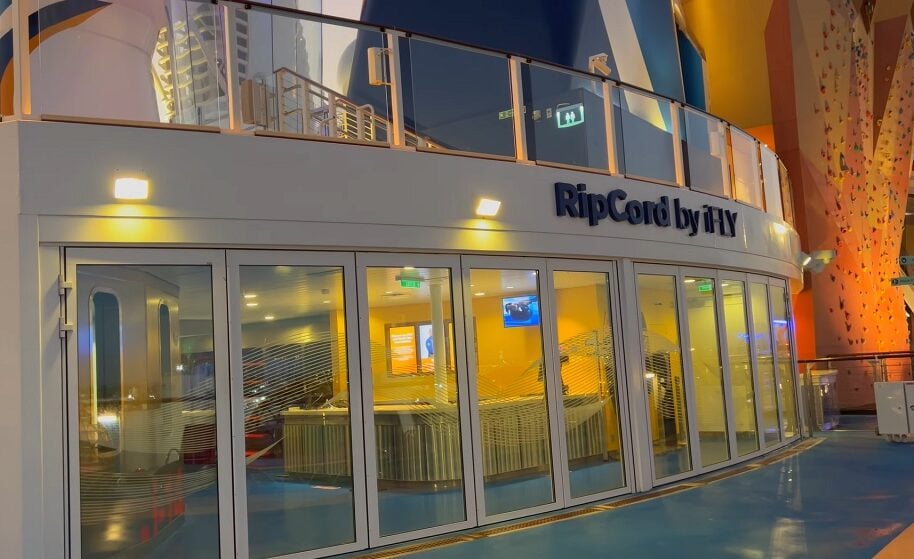
Royal Caribbean calls it RipCord by iFLY, and it is exactly what it sounds like… a vertical wind tunnel on a cruise ship that lets you experience the sensation of freefall without jumping out of a plane.
You gear up, go through a training briefing, learn the basic body position, and then step into the tunnel with an instructor. Powerful air lifts your body into a stable floating position while the instructor stays close, guides your posture, and controls the session.
That means two things are true at the same time:
- Yes, you are actually flying in the sense that the air is lifting and stabilizing your body.
- No, it does not feel exactly like real skydiving because it is controlled, short, and designed for beginners.
This is where a lot of people get tripped up. They hear “skydiving simulator” and imagine either a silly tourist attraction or a full-on adrenaline event. In reality, it sits somewhere in between.
My view is that RipCord works best when you understand what it is trying to deliver: a safe, high-novelty, surprisingly legit first taste of freefall motion that almost anyone can try.
Why RipCord by iFLY stands out on Royal Caribbean
There are a lot of cruise activities that sound fun in a brochure and turn out to be fairly ordinary once you are onboard. RipCord is not really one of those.
The reason it stands out is that it still feels unusual even by Royal Caribbean standards. Surf simulators are famous now. Rock walls are familiar. Waterslides are expected on many new ships. But a working skydiving simulator at sea still has real novelty.
That matters because onboard attractions do not all create the same kind of memory.
Some attractions are passive. You watch a show. You admire a view. You take a photo. RipCord is different because it creates one of those quick, very personal vacation moments where you immediately think, okay… that was actually cooler than I expected.
That is why it consistently remains one of the signature bragging-rights activities on Quantum-class ships.
What Royal Caribbean Skydiving Simulator Feels Like in Real Life
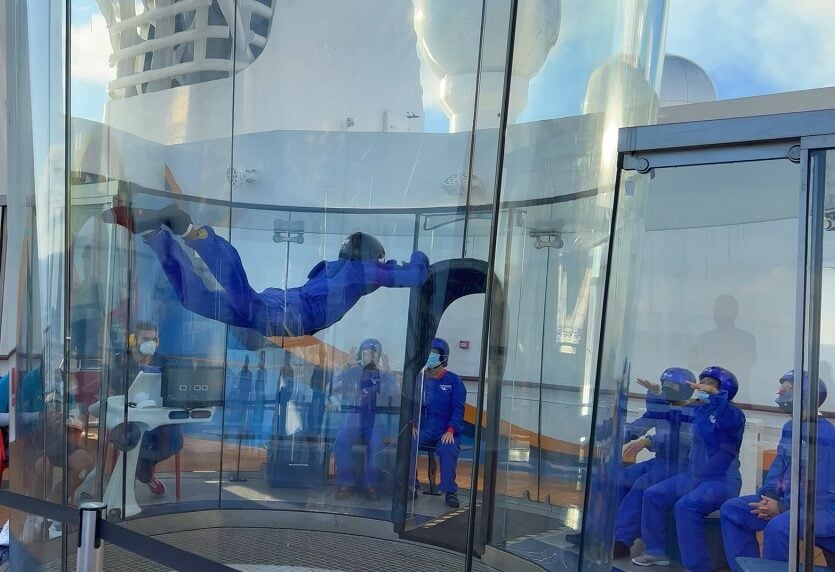
This is probably the most important section in the whole article because expectation mismatch is what makes or breaks the experience.
Here is what most cruisers should expect.
1. The first few seconds are the best part.
When the wind catches you and you realize you are actually floating, there is a very specific mental shift that happens. You go from watching other people do it to understanding the sensation in your own body.
That first moment is usually the payoff.
Not because it is terrifying, but because it feels weirdly unnatural in a fun way. Your brain knows you are inside a chamber on a cruise ship. Your body suddenly feels like the floor stopped mattering.
2. It is more controlled than extreme.
This is the part thrill-seekers sometimes misunderstand.
RipCord does not usually feel like a huge adrenaline bomb. It is not a launch coaster. It is not Crown’s Edge. It is not even necessarily more intense than a solid FlowRider wipeout for some people.
It is more about lift, control, body position, and novelty than about fear.
That does not mean it is boring. It means the thrill is different.
The sensation is closer to a brief, physical, confidence-building freefall lesson than a chaotic rush.
3. The Royal Caribbean skydiving simulator is short
Another important truth… the actual flying time is not long.
That is one reason people either love it or shrug at it. If your expectation is “I want a cool story and a fun memory,” the duration can feel fine. If your expectation is “I want a long signature activity that takes over my afternoon,” it will probably feel underwhelming.
This is one of the most important trade-offs to understand before you start chasing reservations.
4. The Royal Caribbean skydiving simulator can feel awkward before it feels smooth.
Most beginners are not naturals the first second they step in.
That is normal.
The body position matters. The instructor matters. Your ability to relax matters. If you are stiff, tense, or overcorrecting, the session can feel more clumsy than graceful.
That is not a failure. It is just part of the experience.
In fact, one reason people often enjoy RipCord more than expected is because the instructor helps make the whole thing feel approachable rather than intimidating.
The Non-obvious Insight Most People Miss About the Royal Caribbean Skydiving Simulator
Here is the biggest thing I think generic cruise articles usually get wrong…
RipCord is not really a thrill ride. It is a novelty-plus-confidence activity. That distinction changes how you should evaluate it.
If you treat it like a major thrill ride, you may oversell it in your own head and come away a little underwhelmed.
If you treat it like one of the most unusual, accessible, cruise-only physical experiences in the fleet, it starts to make much more sense.
That is especially true for families and mixed-age groups. A lot of cruise thrills have sharp drop-offs in who can enjoy them. Some people do not want to surf. Some do not want waterslides. Some hate heights. Some do not like getting soaked.
RipCord often hits a sweet spot where it feels exciting but still manageable.
That is why I think it punches above its weight in terms of memory value even though the actual flight time is short.
Is the Royal Caribbean Skydiving Simulator Worth It?
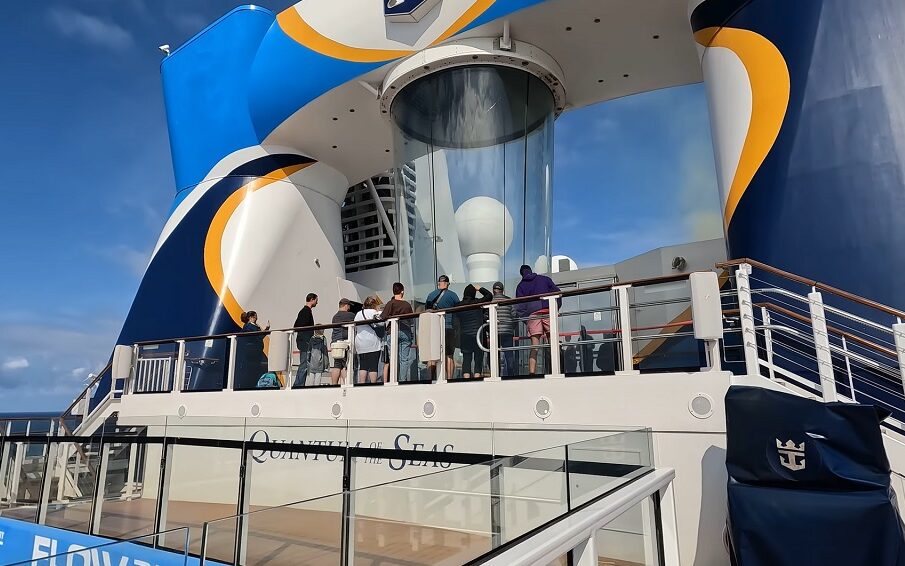
For the average cruiser, the answer is usually yes… with conditions.
It is worth it if you…
- Have never tried indoor skydiving before
- Want a memorable cruise-only experience
- Are sailing on a ship that offers it and can reserve it without derailing your day
- Enjoy trying signature attractions at least once
- Are traveling with older kids or teens who want something more interesting than just pools and trivia
It is not especially worth it if you…
- Already have lots of indoor skydiving experience
- Are expecting something intense and long
- The cruise schedule is packed, and you hate appointment-style fun
- Are very sensitive to whether something feels “worth the time”
- Would need to pay extra for a longer session, and you are value-focused
My view is simple: the included session is usually worth chasing once; the paid upsell makes a lot more sense only for people who know they already like it.
That is one of the cleanest decision rules in this whole guide.
Is Royal Caribbean Skydiving Simulator Free, or Do You Have to Pay?
This is where things get a little confusing because both things can be true depending on what you book.
Royal Caribbean has described Royal Caribbean Skydiving Simulator by RipCord as a complimentary onboard activity when offered in port, which is a big part of why it gets so much buzz. At the same time, Cruise Planner listings on some sailings show extra paid options such as one-minute flights, two-minute flight experiences, and group coaching.
So the practical answer is this:
- A basic experience is often complimentary when the ship is in port
- Additional or upgraded flight experiences may be sold for an extra charge
- Availability and exact setup can vary by ship and sailing
That means you should not write this off as either fully free or always extra. On a real cruise, the smart move is to think in tiers.
The best-value play
If you can get a complimentary session that fits neatly into your cruise schedule, that is the sweet spot.
That is where RipCord shines.
You get the novelty, the story, the sensation, and the memory without having to judge it like a major paid attraction.
When paying extra can make sense
Paying extra starts making more sense when you:
- Already know you enjoy indoor skydiving
- Want more flight time than the base session offers
- Are cruising with someone who is especially excited about it
- The rest of your cruise priorities are already covered
If you are price-sensitive, though, this is exactly where I would slow down. Land-based indoor skydiving can sometimes be the better pure-value play if your main goal is more serious flight time rather than a one-off cruise memory.
What ships have the Royal Caribbean skydiving simulator?
RipCord by iFLY is associated with Quantum Class and Quantum Ultra Class ships rather than being a fleetwide Royal Caribbean feature.
That is why the ship decision matters so much. You will usually see RipCord discussed with ships like
- Quantum of the Seas
- Anthem of the Seas
- Ovation of the Seas
- Spectrum of the Seas
- Odyssey of the Seas
That said, onboard offerings can vary by ship and sailing, and Royal Caribbean’s own pages can be inconsistent in how they surface activity availability at any given moment. So if RipCord is a major booking driver for you, double-check the current ship page and your sailing’s Cruise Planner once available.
This is also why Royal Caribbean ships by age and Royal Caribbean ship classes are useful context. RipCord is a class identity feature, not something you should expect on Oasis, Icon, Freedom, or Voyager-class ships.
How the Booking Process Usually Works
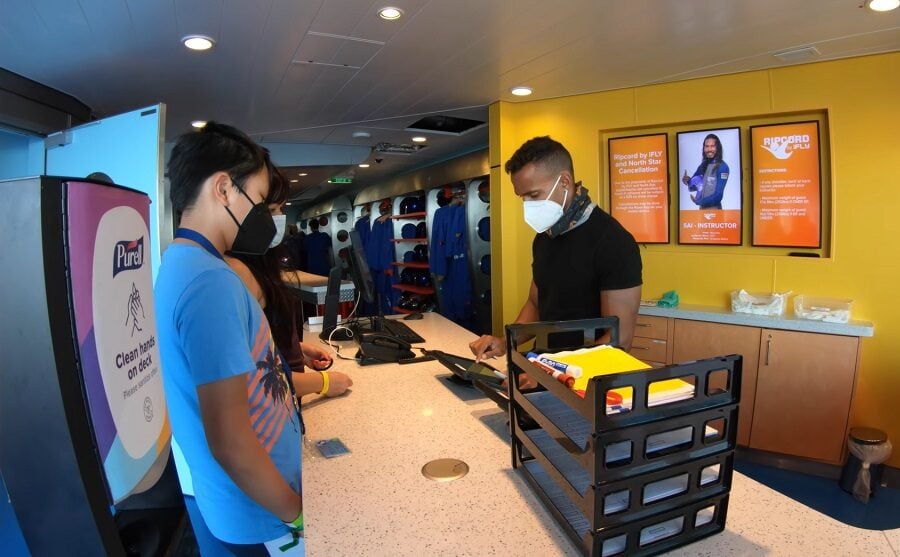
One of the most important practical questions is not whether RipCord looks cool. It is whether it is annoying to book.
Sometimes… yes.
What tends to happen
The general flow usually looks something like this:
- You find the activity in the app or onboard schedule.
- You reserve a time or line up depending on the sailing setup.
- You show up early for check-in and briefing.
- You get suited up and go through safety instructions.
- You wait your turn with the rest of the group.
- You fly for a short session with the instructor.
The actual flying may be brief, but the total time commitment can be noticeably longer once briefing, gearing up, and waiting are included.
That does not automatically make it a bad use of time. It just means you should not plan your day as though this is a two-minute in-and-out activity.
Should you reserve early?
In my opinion… yes.
If RipCord matters to you at all, I would try to lock it in early rather than treating it casually.
Why?
Because the exact people most interested in it are the same people most likely to book it early:
- families with active kids
- first-time cruisers chasing signature attractions
- travelers on port-heavy itineraries trying to plan efficiently
Anything that is short, famous, and capacity-limited can get annoying fast if you wait too long.
Is it better on port days?
Often, yes.
This is one of the smartest planning moves in the whole article.
Because complimentary RipCord sessions are often tied to port-day operation, and because many cruisers are off the ship exploring, a port day can be the best chance to fit it in without the same sea-day crowd pressure.
That is a huge deal.
If you are the kind of cruiser who likes maximizing ship attractions while everyone else is off in port, RipCord can be a really smart use of that quieter window.
What the Whole Experience Looks Like Step by Step
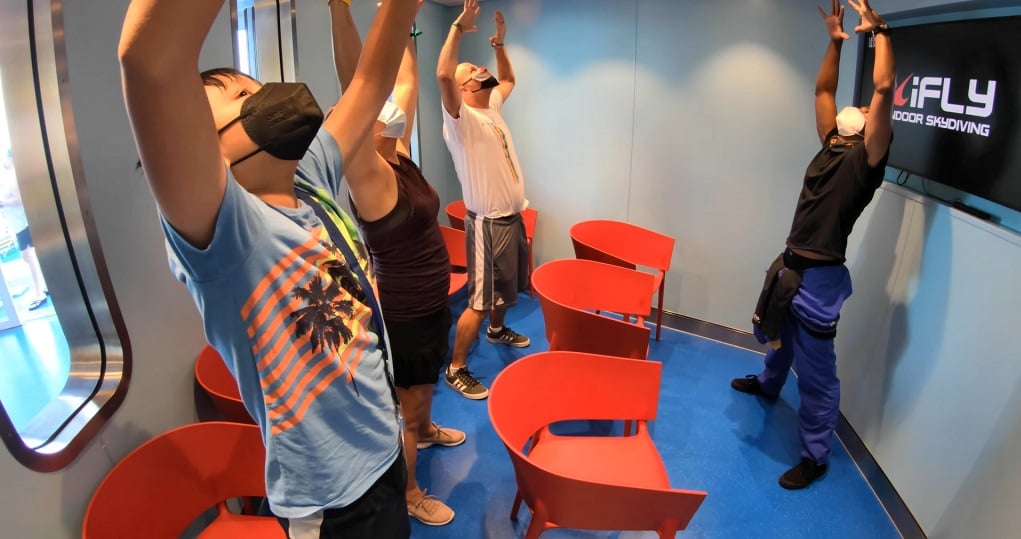
A lot of people are curious about what actually happens, not just the headline.
Here is the typical rhythm.
Step 1: Check in and sign what you need to sign.
Before you do anything, you handle the paperwork and make sure you meet the basic requirements.
This is where restrictions matter. If you are unsure about weight, health, age, or general fit, do not assume you will be able to talk your way around them once you get there.
Step 2: Gear up.
You will be fitted with the required equipment.
That is part of why the experience feels more legit than gimmicky. It has a real procedure to it. You are not just stepping into a random fan chamber in vacation clothes.
Step 3: Learn the body position.
The briefing is more important than some people expect.
Small changes in your arch, arm placement, chin position, and leg position affect how stable you feel. This is not hard in a technical sense, but it is not automatic either.
The people who have the best first flights usually do two things well:
- They listen carefully
- They stay loose and let the instructor help
Step 4: Wait your turn.
This is the least glamorous part.
Depending on the sailing and setup, there can be some waiting involved. That is one reason RipCord is not the best activity for impatient people who want instant gratification.
Step 5: Enter the tunnel.
Then comes the payoff.
You step in, the wind catches you, and the instructor helps position you. That first stable lift is the moment most people remember.
Step 6: Adjust, float, grin, and finish before you are emotionally ready.
That may sound dramatic, but it is true for a lot of first-timers.
The session often feels short enough that you would gladly take more. In a weird way, that is part of why people remember it positively. It ends before the novelty wears off.
What It Is Like for Kids, Teens, Adults, and Nervous First-timers
One reason RipCord works so well as cruise content is that it is not aimed at only one type of traveler.
For kids and teens
This is often a major winner.
If you have a kid who is too old for little-kid attractions but not yet jaded enough to roll their eyes at cruise activities, RipCord can be right in the sweet spot. It feels rare, active, and brag-worthy.
Teens especially tend to like experiences that sound cooler when they tell the story later. RipCord absolutely qualifies.
For adults who want something different
A lot of adults end up enjoying RipCord more than they expect because it is not just passive entertainment.
It asks you to participate. It creates a real physical sensation. It gives you something to remember that is different from “we watched a good show” or “we had nice drinks.” That matters.
For nervous first-timers
This may actually be a better fit than you think.
Because the environment is controlled and instructor-led, RipCord can work well for travelers who are curious about freefall but would never do actual skydiving.
That is one of its most underrated strengths.
For serious thrill-seekers
This is where you should be more careful.
If someone in your group wants max adrenaline, there is a real chance they come away saying, “That was cool… but short.”
Not a bad reaction. Just not an earth-shattering one.
Restrictions, Safety, and Who Should Think Twice
This is where honesty matters more than hype.
Royal Caribbean publishes baseline restrictions for RipCord, and there are also common-sense physical considerations that matter with indoor skydiving generally.
Core Royal Caribbean restrictions
Royal Caribbean states that guests must:
- be at least 3 years old
- weigh less than 230 pounds if under 6 feet tall
- weigh less than 250 pounds if 6 feet or taller
- Wear the equipment provided
Those are not small details. They can decide the whole issue before you even get to the fun part.
Health and physical condition matter too
This is another place where I would not try to be macho about it.
Indoor skydiving involves body control, wind force, and instructor-assisted positioning. If you have head, neck, back, shoulder, or heart-related concerns, or anything else that could make physical activity risky, you need to be careful.
The big takeaway here is simple: RipCord looks approachable, but it is still a real physical activity.
That is not meant to scare you off. It is meant to keep expectations realistic.
Does Royal Caribbean Skydiving Simulator feel safe?
From a design standpoint, RipCord is about as confidence-friendly as a skydiving-style attraction can reasonably be.
You are not jumping from height. You are not attached to some huge swinging mechanical system. You are in a controlled chamber with an instructor right there, and the whole experience is built around getting beginners through it safely.
That is one reason it works so well for family cruising.
A good rule of thumb is this:
- If your hesitation is mostly nerves, RipCord is probably more approachable than you expect.
- If your hesitation is based on a real physical limitation, treat that seriously.
What to Wear and How to Prepare for Royal Caribbean Skydiving Simulator
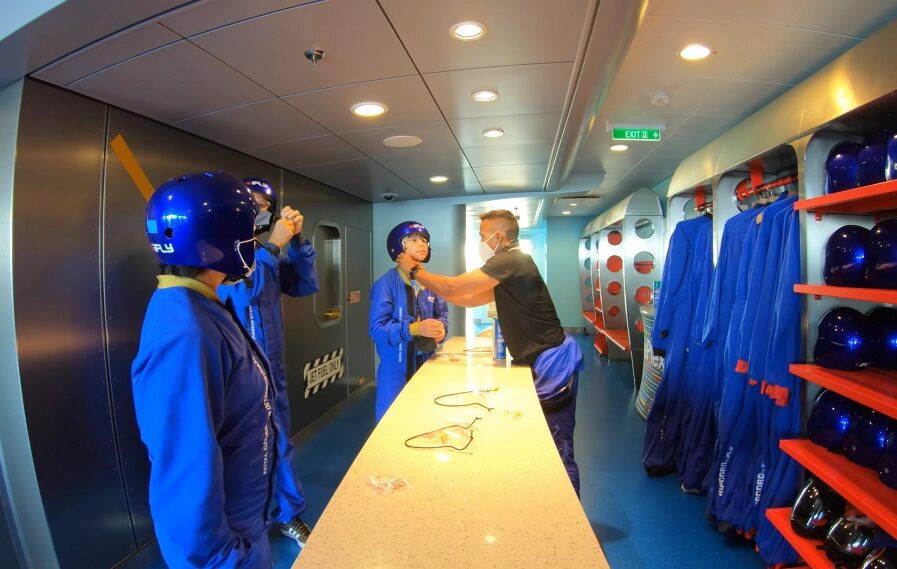
This is not the most glamorous section, but it can improve your experience a lot.
Keep your expectations simple.
You are not dressing for photos. You are dressing to listen, suit up, and move properly.
Show up on time.
This sounds obvious, but attractions like this get much more annoying when people treat them casually and then feel rushed.
Listen during the briefing.
I cannot overstate this enough.
Because the flight is short, the quality of the briefing matters more. Your body position is the difference between “that was incredible” and “that felt awkward and over fast.”
Stay relaxed.
People often do worse when they try too hard.
This is one of those activities where calm beats intensity.
How RipCord Compares to Other Royal Caribbean Thrill Activities
This is where decision-first blogging matters. Readers are not always asking whether RipCord is good. Sometimes they are asking which attraction deserves their time most.
RipCord vs FlowRider
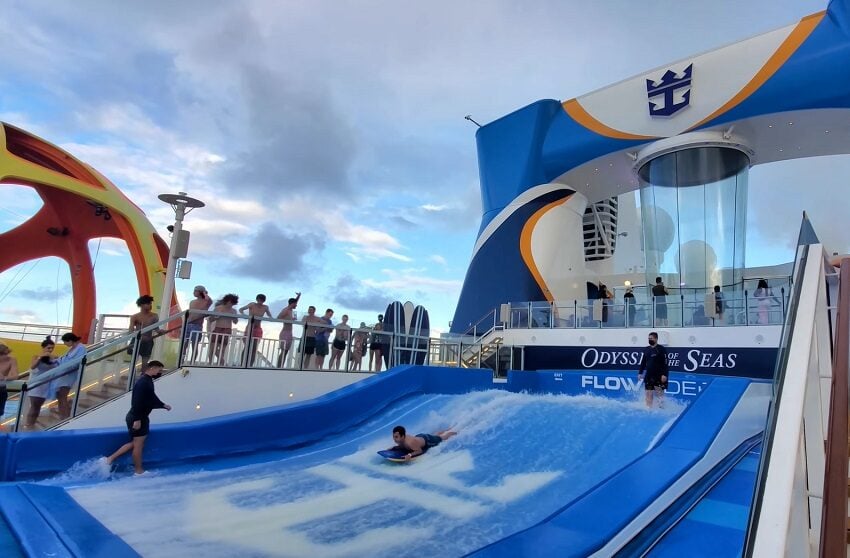
This is one of the best comparisons because both attractions are famous, active, and tied strongly to ship identity.
| Attraction | Better for |
|---|---|
| RipCord by iFLY | First-timers, novelty seekers, families wanting a short shared experience |
| FlowRider | Repeat attempts, more visible action, people willing to wipe out and keep trying |
My honest take? If someone is only doing one signature physical Royal Caribbean attraction and wants maximum repeat value, I usually think Royal Caribbean FlowRider has the edge.
But if they want the more unusual, more conversation-starting, more cruise-only flex, RipCord is the better story.
RipCord vs. North Star
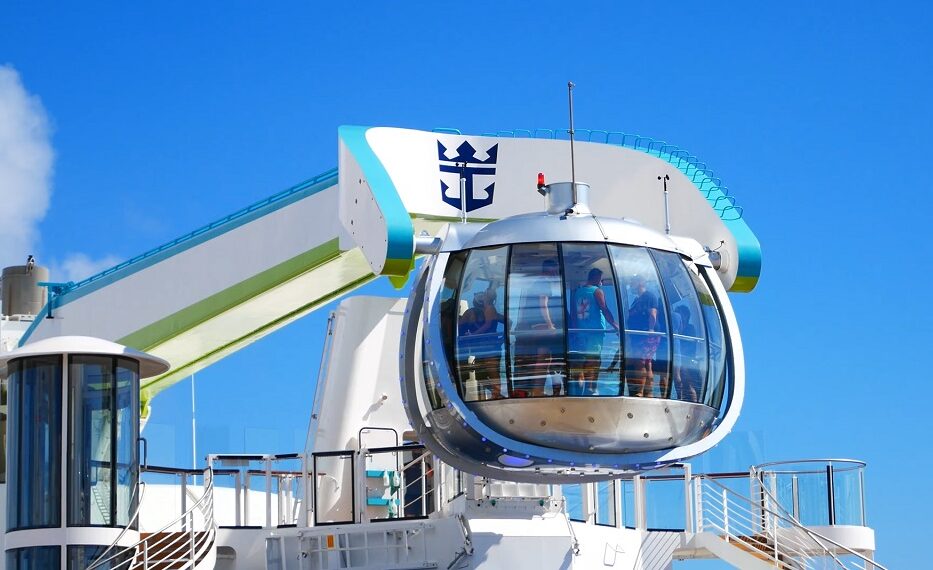
North Star is scenic. RipCord is physical.
If your idea of fun is views, photos, and a gentler wow moment, North Star will likely be more your speed.
If your idea of fun is doing something active you probably cannot do on most other vacations, RipCord has the advantage.
RipCord vs. waterslides
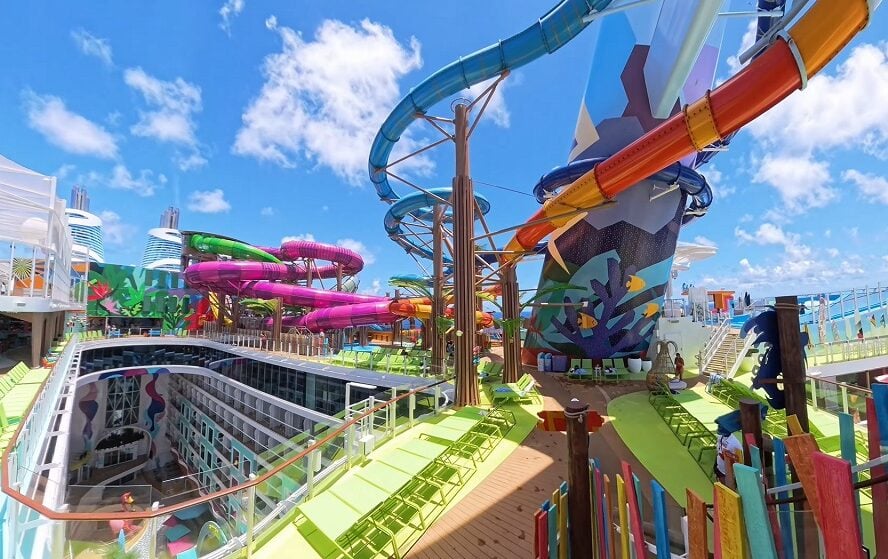
Water slides often win on instant fun, especially for families doing multiple laps. RipCord wins on uniqueness.
This is another place where novelty matters. A great waterslide is still a waterslide. RipCord is one of those activities that instantly makes people say, “Wait… you did that on a cruise ship?”
RipCord vs. land-based iFLY
This is a very important comparison, especially for value-focused readers.
Where the cruise version wins
- the novelty of doing it at sea
- the bragging rights
- the ocean backdrop
- the convenience if it is complimentary and already onboard
Where land-based iFLY can win
- more serious flight focus
- more flexible booking
- better value if your goal is longer flight time
- easier to justify repeating if you want to improve
This is the key judgment call:
If your main goal is to experience indoor skydiving at all, the cruise version is great. If your main goal is to get deeper into indoor skydiving as a hobby or skill, land-based iFLY usually makes more sense.
That is a subtle point, but it makes your decision much easier.
Should RipCord Affect Which Ship You Book?
Usually not by itself.
That is one of the clearest pieces of advice I can give.
RipCord is a really cool attraction. It is not usually a strong enough reason on its own to pick one ship over another unless:
- You are already choosing between similar quantum-class options
- You know someone in your group is especially excited about it
- You love active attractions and want a ship built around them
But I would not tell most readers to choose a ship they otherwise like less just because it has RipCord.
That is too much weight to put on a short onboard activity. Where it matters more is as a tiebreaker.
If two itineraries and prices are close, RipCord can absolutely become part of the value argument.
Best Royal Caribbean Ships for RipCord Fans
Since RipCord lives on Quantum and Quantum Ultra ships, the best ships for it are usually the ships that also pair it with other strong activity offerings.
Anthem of the Seas
Good for travelers who want a classic Quantum-style activity mix with North Star, SeaPlex, and a strong all-weather appeal.
Ovation of the Seas
Often a great fit for travelers who like the idea of pairing scenic itineraries with standout onboard features.
Odyssey of the Seas
Probably one of the easiest ships to recommend to activity-focused families because it stacks RipCord with a lot of other modern attractions.
Spectrum of the Seas
Interesting for travelers in the Asia market or anyone specifically sailing this ship and wanting the full Quantum Ultra feel.
Quantum of the Seas
Still important in the conversation because it helped define the class identity, though exact onboard activity availability should always be verified by sailing.
I would not force a hard one-size-fits-all ranking here because itineraries, homeports, and pricing change the recommendation a lot. But as a general rule, RipCord fans should be looking at the Quantum family first, not hoping to find it somewhere else in the fleet.
Who Should Absolutely Try the Royal Caribbean Skydiving Simulator
This is where I think the decision becomes very clear.
First-time experience collectors
If you love vacation memories built around doing something new, RipCord is a very strong fit.
Families with older kids or teens
This is one of the most dependable sweet spots.
It is unusual enough to feel special, short enough not to take over the day, and approachable enough that it can work across age groups.
Curious non-skydivers
If you think actual skydiving sounds cool but way too intense, RipCord may be the perfect compromise.
Royal Caribbean fans who like signature attractions
If you enjoy trying the activities that make each Royal Caribbean class distinctive, RipCord is one of the clearest examples of that mindset.
Who Should Skip the Royal Caribbean Skydiving Simulator
A good pillar post always says who should skip the thing.
Experienced indoor skydivers
If you already know and love land-based iFLY, the cruise version may feel more like a novelty demo than a serious session.
Thrill-seekers chasing intensity
If you want a giant adrenaline hit, RipCord may feel more controlled and brief than you want.
Time maximizers
If you hate spending extra time on brief activities, this may not be your best use of limited cruise hours.
Budget-sensitive cruisers considering paid add-ons
If you are only interested once the upsell sessions appear, I would compare that spend against other cruise priorities first.
Common Mistakes to Avoid: Royal Caribbean Skydiving Simulator
Expecting a full real-skydiving adrenaline rush
Why it is a problem: RipCord recreates the sensation of floating and freefall movement, but it is still a controlled, beginner-friendly indoor experience rather than a true jump.
Extra considerations: People who walk in expecting something huge and extreme are much more likely to feel underwhelmed.
Better alternatives: Think of it as a short, unusual, high-novelty experience… not a replacement for actual skydiving.
Waiting too long to book it
Why it is a problem: Signature onboard activities with limited capacity can get awkwardly competitive, especially when families and first-time cruisers all target the same slots.
Extra considerations: Port days can be the best opportunity, and missing the timing can mean missing the experience.
Better alternatives: Reserve early and build the rest of your day around it once confirmed.
Paying extra without asking whether you even like it
Why it is a problem: The basic included experience is often enough for many cruisers, and paying extra before you know your reaction can be poor value.
Extra considerations: This matters most for price-sensitive travelers and anyone already juggling other cruise add-ons.
Better alternatives: Do the base experience first if possible, then decide whether additional flight time is actually worth it.
Ignoring the physical side of the activity
Why it is a problem: RipCord looks approachable, but it still involves body position, wind force, and physical control.
Extra considerations: Health conditions, prior injuries, and weight or age restrictions can matter more than some guests expect.
Better alternatives: Treat the restrictions seriously and opt out if your body is telling you this is not the right activity.
How to Decide if the Royal Caribbean Skydiving Simulator is Worth Your Cruise Time
If you are still on the fence, ask yourself these four questions.
1. Do I care more about novelty or intensity?
If the answer is novelty, RipCord moves up your list.
2. Am I likely to regret skipping it?
Some cruisers know themselves. They do not need to do every attraction, but they also know which ones will nag at them later.
RipCord can be one of those.
3. Would I still want it if it only takes a few minutes?
That is the truth test.
If the short duration already bothers you, your expectations may be misaligned.
4. What am I giving up to do it?
This is huge on port days.
If doing RipCord means skipping something you care about more, the answer may be easy. But if it fits naturally into your day while many guests are ashore, it becomes much easier to recommend.
My Research-Based Take on Whether Kids and Families Should Prioritize It
I have sailed Royal Caribbean many times, and one thing I pay attention to constantly is which attractions create actual family stories versus which ones just look good in marketing.
RipCord seems to create a lot of genuine family payoff for a few reasons:
- It is spectator-friendly
- It feels safe enough for many cautious parents
- It gives kids and teens something unusual to talk about afterward
- It works well as a short shared win rather than a huge logistical event
That said, I would not oversell it for little kids, very timid kids, or families whose children are more excited by pools, splash zones, arcade time, or youth club activities.
In other words, RipCord is a great family bonus, not an automatic family centerpiece.
The Best-Case and Worst-Case Versions of Royal Caribbean Skydiving Simulator Experience
Sometimes the easiest way to help readers decide is to show the range.
Best case
You reserve it early, show up on time, get a good instructor, relax into the body position, and walk away grinning because you just floated inside a skydiving tunnel on a cruise ship.
That is the sweet spot. Quick, memorable, and totally worth it.
Worst case
You build it up too much, struggle to get a slot, wait longer than expected, feel awkward in the tunnel, and then finish thinking, “That was cool, but not worth all that effort.”
That scenario is not a disaster. But it does explain why some reviews come in more lukewarm.
The biggest predictor of which version you get is not bravery. It is expectation management plus planning.
How weather, Port-Timing, and Cruise Rhythm can Change the Recommendation
This is a very cruise-specific angle that generic activity posts often ignore.
RipCord is not being evaluated in a vacuum. It is being evaluated inside a vacation with ports, meals, shows, naps, ship exploration, and maybe family scheduling chaos.
That means the same attraction can feel much better or much worse depending on context.
On a seaside day
You may face more demand and more competition for time.
On a port day
You may have a better chance of fitting it in cleanly if you are staying onboard or returning early.
On a short cruise
It may feel more like a luxury add-on to your schedule because everything is compressed.
On a longer cruise
It becomes easier to view as a nice bonus rather than something you must force.
This is one reason I like RipCord more on longer sailings or port-heavy itineraries where you can use ship time strategically.
What I Would Do Personally
This deserves its own section because it helps readers make faster decisions.
If it were me, here is exactly how I would play it.
I would:
- Target a complimentary session first
- Try to book it early
- Aim for a time that does not compete with a must-do meal, show, or port plan
- Treat it as a one-time highlight, not a schedule anchor
- stay open to paying extra only if I came off the first session genuinely wanting more
I would not:
- Build my whole cruise around it
- Overpay for extra time before I knew whether I liked it
- Choose a ship I otherwise preferred less just for RipCord alone
That is the balanced approach I think most readers actually need.
Jim’s Take About Royal Caribbean Skydiving Simulator

The Royal Caribbean skydiving simulator is one of those attractions where honesty matters more than hype.
I have sailed Royal Caribbean 15 times, and I have done a ton of research on RipCord by iFLY… watched walkthroughs, read recent passenger feedback, compared official ship info, and paid attention to where the experience seems to genuinely land for people.
But I have to be straight with you… I have not personally tried RipCord myself yet.
That matters, and I want to be upfront about it.
So here is my honest judgment based on all of that research and my broader Royal Caribbean experience.
My view is that RipCord looks better than a gimmick but smaller than a true headline thrill. That is not criticism. It is actually why I think it works so well.
It gives cruisers something unusual, physical, memorable, and very Royal Caribbean without demanding that they be extreme thrill-seekers.
If it were me, I would absolutely try the Royal Caribbean skydiving simulator once on the right sailing, especially if I could grab a complimentary session that fit naturally into a port day. I would go in expecting a cool, short, conversation-starting memory… not some life-changing adrenaline event.
And honestly, that is probably the exact mindset that leads to the best outcome.
Final Recommendation: Royal Caribbean Skydiving Simulator
The Royal Caribbean skydiving simulator is worth doing for most curious first-timers, especially on Quantum and Quantum Ultra ships, where it functions as one of the class-defining signature attractions.
The best way to think about it is this:
RipCord by iFLY is not the main reason to cruise, but it can absolutely become one of the coolest “only on this kind of ship” moments of the trip.
That is why I recommend it for people who value novelty, shared family memories, and trying the attractions that make Royal Caribbean feel different.
I do not recommend building your whole booking decision around it. I do recommend trying it once if the timing works, the restrictions fit, and you go in with the right expectations.
That is the sweet spot.
FAQs: Royal Caribbean Skydiving Simulator
Is the Royal Caribbean skydiving simulator free?
Usually, a base RipCord by iFLY experience is offered as a complimentary activity when the ship is in port, but extra paid flight options can appear depending on the sailing.
How long do you actually fly?
The actual tunnel time is short, which is why the experience feels more like a memorable one-off than a long-form attraction.
Does it feel like real skydiving?
It recreates the floating freefall sensation surprisingly well, but it is much more controlled, beginner-friendly, and less intense than jumping from a plane.
Is RipCord by iFLY scary?
For most people, it is more unusual and exciting than truly scary.
Can kids do the Royal Caribbean skydiving simulator?
Yes, many kids can, but age and weight restrictions apply, and the experience works best for children who are comfortable following instructions.
What ships have RipCord by iFLY?
It is generally found on Quantum Class and Quantum Ultra Class ships rather than across the whole Royal Caribbean fleet.
Is it worth paying extra for longer sessions?
Usually only if you already know you enjoy indoor skydiving or you finish the included experience wanting more.
Should I book it early?
Yes. If RipCord matters to you at all, early planning is usually the smart move.
Is it better than FlowRider?
Not universally. RipCord is more unusual and more beginner-friendly, while FlowRider often has stronger repeat value for active cruisers.
Should RipCord decide which ship I book
Usually no. It is best used as a tiebreaker, not the whole reason to choose one ship over another.